Adaptation to climate change
Episodes of heavy rain, heat waves, and extreme weather events are becoming increasingly frequent. These events have an impact on municipal infrastructure, living environments, and the population’s quality of life.
To make its territory more resilient to climate change, the Ville de Saint-Lambert has undertaken an initiative to plan and implement green infrastructure. These projects will, in particular, improve stormwater management, reduce heat islands, and provide more pleasant and safer living environments.
This initiative is being carried out with financial support from the Government of Quebec through the OASIS program, which is part of the 2030 Plan for a Green Economy.

The OASIS program
The OASIS program supports municipalities in adapting their communities to climate change. It promotes the development of resilient spaces—that is, places capable of adapting to climate change while remaining pleasant and accessible.
Acting as green infrastructure, these developments help, among other things, to:
- cool the city during heat waves;
- manage stormwater and reduce the risk of flooding;
- provide spaces for socializing and relaxation;
- contribute to the ecological transition.
These developments can take various forms: rain gardens, vegetated swales, retention basins, sponge parks, tree plantings, etc.
The OASIS program is divided into three components:
- Component 1: development of an adaptation plan;
- Component 2: implementation of green infrastructure;
- Component 3: maintenance and sustainability of the infrastructure.
Phase 1 – Development of the Adaptation Plan (COMPLETED)
In the fall of 2025, the City undertook the first phase of its initiative by developing a climate change adaptation plan. Carried out with the support of a specialized firm, this plan made it possible to:
- analyze the risks associated with heat waves and heavy rainfall in the area;
- identify priority action areas;
- propose development concepts for these areas.
This first phase represented an investment of $250,000, 80% of which was funded by the Government of Quebec under the OASIS program (volet 1), which is part of the 2030 Plan for a Green Economy.
Three Priority Action Areas
Three priority action areas were thus identified:
- Gordon Park;
- Village Park;
- the public parking lot on Notre-Dame Avenue.
The selected sites were chosen based on their climate vulnerability, potential for intervention, public accessibility, and ability to generate environmental and social co-benefits. The green infrastructure will be developed on municipal public sites that are heavily frequented by the public and will be accessible to everyone. The developments will be designed according to the principles of universal accessibility to ensure they can be used by people with reduced mobility.
Public Consultation
As part of the plan’s implementation, a public consultation was held on February 5, 2026. Approximately 50 citizens took part in this consultation. Those in attendance learned more about the context, the site selection method, and the principles of resilient development. Following that, three co-creation workshops focusing on the selected sites were held. The feedback received helped improve the adaptation plan.
You can consult
Phase 2 - Implementation of Improvements (IN PROGRESS)
Following the completion of the adaptation plan, the City of Saint-Lambert received, in June 2026, $4.8 million in financial assistance under Phase 2 of the OASIS program to carry out the planned improvements and move into the implementation phase.
Thanks to this major investment, three key projects will be carried out between 2027 and 2029 at Gordon Park, Village Park, and the public parking lot on Notre-Dame Avenue.
These projects prioritize the implementation of climate change adaptation measures while preserving the identity, uses, and atmosphere of the targeted public spaces.
The Three Projects
1) Gordon Park
Scheduled completion: 2027
The first project focuses on Gordon Park, a popular recreational spot known for its peaceful atmosphere, iconic fountain, and rose beds that give it the charm of an English garden.
The planned improvements are as follows:
- installation of new storm drains* around the park to direct water from neighboring streets toward retention basins, located in areas where tree roots will not be affected;
- creation of vegetated swales in locations where they can optimally capture and infiltrate water, without altering the park’s uses or atmosphere;
- refurbishment of street furniture and the addition of a new bench with a permeable base to promote water infiltration;
- preservation of all existing trees and enrichment of the vegetation to enhance biodiversity.
To view the project’s development plan, click here.
* Storm drain: a structured opening designed to capture stormwater and direct it to a stormwater management system.
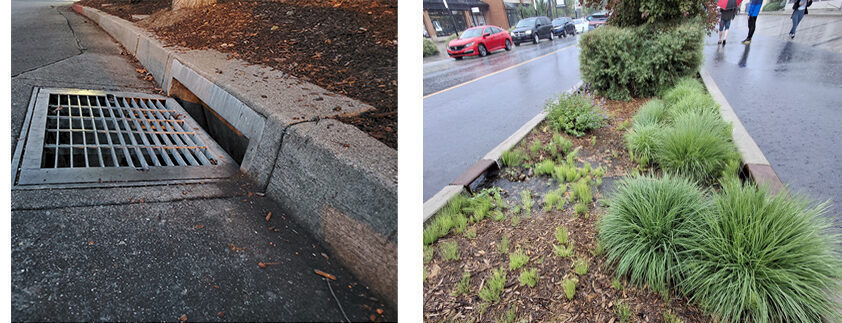
Image above: example of a storm drain and a vegetated swale
2) Village Park
Planned completion: 2028
The second project focuses on Village Park. Characterized by its mature trees, this park is located in the heart of downtown and remains a gathering place for families, appreciated for the variety of community events and activities that take place there throughout the four seasons.
The planned improvements are as follows:
- replacing paved surfaces used for gatherings and pedestrian traffic with permeable pavers that allow water to infiltrate;
- adding vegetated swales to collect and infiltrate stormwater;
- installation of storm drains, lowering of sidewalks, and expansion of green medians along Elm Street, near the intersection with Victoria Avenue.
To view the project’s development plan, click here.
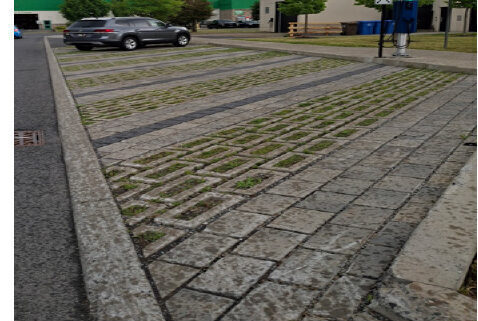
Image above: example of permeable pavers
3) Notre-Dame Avenue Parking Facility
Scheduled completion: 2028
The third project focuses on the public parking lot on Notre-Dame Avenue. It will undergo a major transformation aimed at improving stormwater management while retaining the vast majority of parking spaces. The goal is to make the site more sustainable and better equipped to handle heavy rainfall, while reducing heat islands.
To ensure the optimal integration of this green infrastructure, eight parking spaces located at the front of the block will be removed. This change is a necessary compromise to allow for the implementation of the improvements and to generate significant environmental benefits.
The planned improvements are as follows:
- planting new, large-canopy trees to increase shade, reduce heat islands, and improve the quality of the landscape;
- adding drainage swales directed toward vegetated medians, using the natural slope of the land to channel water toward these infiltration areas;
- replacing the current paving with permeable pavers, which will reduce impervious surfaces and allow water to infiltrate directly into the ground.
To view the project’s development plan, click here.
Phase 3 – Maintenance and Sustainability of Infrastructure (COMING SOON)
Once the green infrastructure has been completed, the City will be able to begin the third and final phase of the initiative: ensuring its maintenance and long-term sustainability. As part of Phase 3 of the OASIS program, the City will be able to develop a sustainability strategy aimed at ensuring that the benefits of the completed projects are maintained and that they are adapted to the area’s future needs.
The City will also be able to submit a request for financial assistance under this phase of the OASIS program to support the implementation of this strategy.